
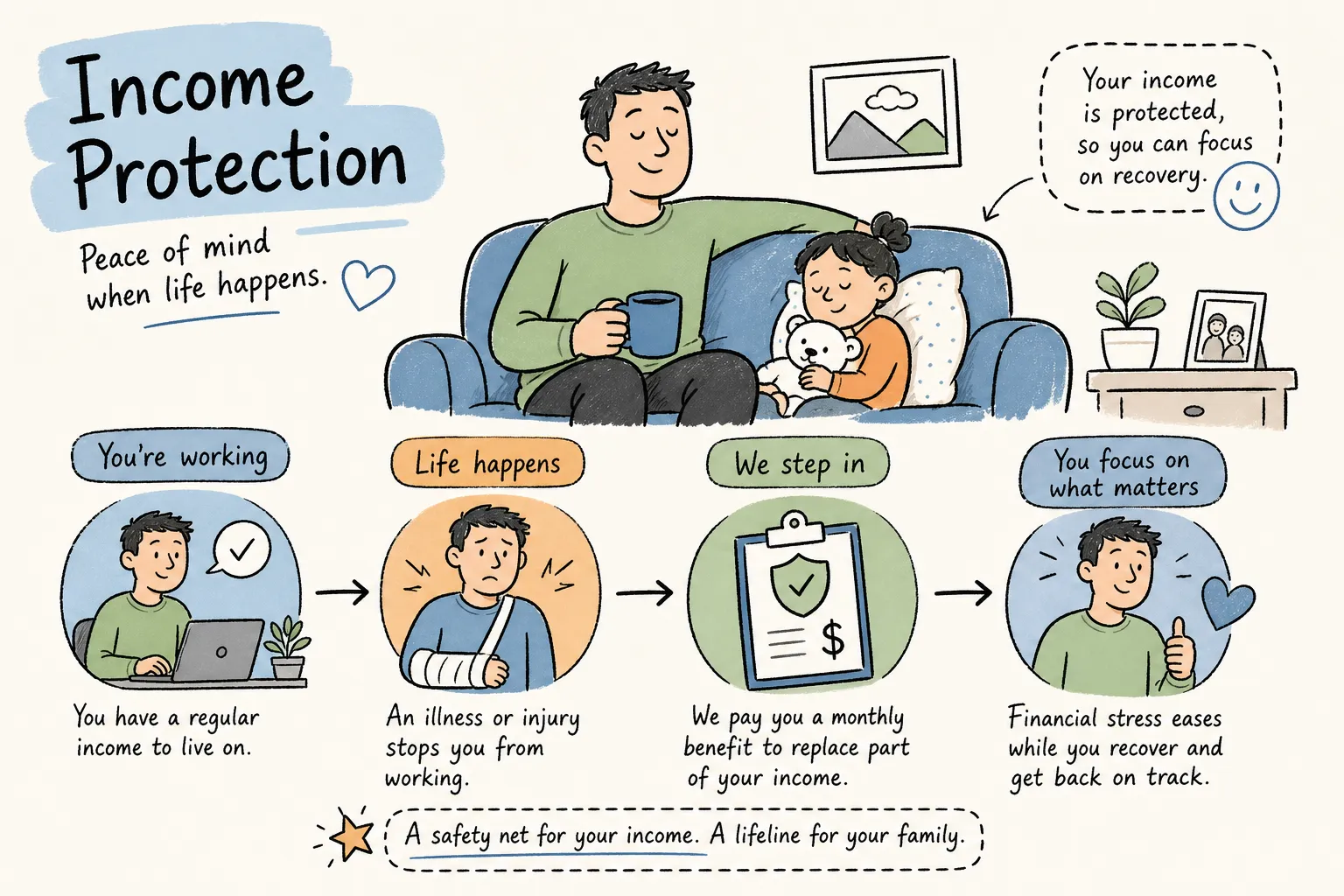
How income protection insurance works in New Zealand
Many people assume ACC has them covered if they can’t work due to illness. Income protection insurance in NZ fills a gap that ACC was never designed to close, and it’s a gap that tends to reveal itself at the worst possible moment. This article covers what income protection insurance NZ policies actually do, how the benefits work, what cover costs, and who needs it most.
The question we hear most often at Pulse Advice is simple: “Do I actually need this?” The answer depends on one thing: how long you could survive financially if your income stopped tomorrow.
What income protection insurance is (and where ACC falls short)
ACC only covers loss of income from accidental injury. Heart disease, cancer, depression, diabetes, a bad back from a degenerative condition, none of these trigger ACC income payments. Illness, not injury, is widely cited as the leading cause of long-term work absence in New Zealand. If you’re off work for six months with a serious health condition, ACC won’t send you a cent.
Income protection insurance pays a monthly benefit, typically up to 75% of your pre-disability gross income, if you’re unable to work due to illness or injury. It’s not a lump sum like life insurance or trauma cover. It replaces your salary, month by month, for as long as the policy allows. That distinction matters a great deal when you’re looking at a long recovery.
One misconception worth clearing up: standard income protection policies do not cover redundancy or voluntary unemployment. Some providers such as AIA and Chubb offer redundancy as an optional add-on rider, but it comes with its own stand-down periods, a benefit capped at around $4,000 per month, and a payout window of only three to six months. It’s a separate product with separate limitations. Pre-existing conditions may also be excluded at underwriting, depending on your health history and the insurer.
How monthly benefit payments actually work
Most New Zealand policies pay between 45% and 75% of your pre-disability gross income, subject to a maximum monthly benefit. AIA, for example, caps this at $20,000 per month. Importantly, the benefit is calculated at claim time based on your income when you become disabled, not when you first took out the policy. If your salary has grown significantly since you applied, that works in your favour.
Benefit periods: short-term vs long-term cover
The benefit period is how long your insurer will keep paying while you remain disabled. Common options for income replacement insurance in New Zealand are two years, five years, or to age 65, with some providers offering to age 70 for certain occupations.
A two-year benefit period typically costs around half the premium of a to-age-65 period, though this varies by insurer and individual circumstances, it’s best treated as a useful illustration rather than a fixed rule. What’s clear is that a two-year limit leaves you exposed if your condition is serious and long-lasting. For conditions like cancer or severe mental illness, claims can extend well beyond two years.
Income protection pays in arrears, after the waiting period has passed. Once a valid claim is approved, which typically takes four to eight weeks from lodgement, you receive regular monthly payments for as long as you qualify under the policy terms. Valid claims in New Zealand are approved at a rate of 85 to 95%. The most common reason for decline is non-disclosure of pre-existing conditions at the time of application, not the claim being medically invalid.
Waiting periods: the decision that changes your premium most
The waiting period (also called the elimination period) is how long you must be unable to work before your policy starts paying. Common options in New Zealand range from two weeks to 104 weeks, with four, eight, 13, and 26 weeks being the most popular choices for salaried employees. You are not paid for the waiting period itself. It’s the time you cover from your own savings, sick leave, or other resources.
The waiting period is the most effective lever for managing your premium. For a 35-year-old earning $80,000, the numbers look roughly like this:
- Four-week wait: approximately $135 per month
- Eight-week wait: approximately $105 per month (22% saving)
- 13-week wait: approximately $80 per month (41% saving)
- 26-week wait: approximately $60 per month (56% saving)
When selecting you waiting period its important to really think about what would happen to you if you were to stop receiving income due to a medical reason, people often see the low premiums of 13 week waiting periods and believe that is best for them, when they wouldnt have the rainy day funds to get them past 4 weeks.
Self-employed people and contractors are a different story. With no employer sick leave to draw on, a four or eight-week waiting period is generally more appropriate for this group, even if the premium is higher. The waiting period decision isn’t just a cost question, it’s a question of how long you could realistically go without income, and whether you’re being honest about that number.
Who needs income protection insurance in NZ most
Under the Holidays Act, most New Zealand employees are entitled to 10 days of sick leave per year. That’s enough for a cold or a minor injury. It is not enough for a cancer diagnosis, a serious mental health episode, or a spinal condition. Once sick leave runs out, there is no employer obligation to keep paying your salary. For households with a mortgage, dependants, or a single income, that exposure is significant.
Self-employed Kiwis and contractors face the starkest risk. There is no sick leave, no employer contribution, and no group insurance cover. If you stop working, income stops immediately. ACC still applies for accidental injury, but illness-related income loss is completely unprotected without a private policy. Disability income cover is arguably more critical for this group than any other, yet uptake among contractors and sole traders appears to remain low relative to their exposure.
Some people in their 20s and 30s assume they’re too young or too healthy to need cover. That assumption is wrong on both counts. Disability claims are not confined to older workers. Locking in income protection at a younger age is cheaper and avoids the medical exclusions that accumulate with age and health history. If a health condition develops before you apply, it may be excluded entirely from any future policy. Waiting doesn’t save you money in the long run.
What drives the cost of income protection insurance NZ
Age is the primary pricing driver. A 30-year-old will pay considerably less than a 50-year-old for identical cover. Most insurers stop accepting new applicants between ages 55 and 62, depending on occupation and insurer.
How occupation class affects your premium
Occupation risk class is the second major factor. Insurers classify occupations from Class 1 (office workers, lowest risk) through to Class 5 (manual labourers and tradies, highest risk). An office worker on a $100,000 salary might pay $670 to $920 per year for a two-year benefit period. A tradie on the same income pays roughly $1,200 to $1,600, nearly double. Some high-risk occupations, including certain trades and physically demanding roles, may be declined outright or offered limited cover.
Benefit period and how it affects price
Extending your benefit period from two years to five years increases the premium by around 20%. Moving to a to-age-65 policy roughly doubles the cost compared to a two-year period. In dollar terms, the difference between a two-year and to-age-65 policy can be as little as $50 per month. For a long-term condition like a spinal injury or serious mental health episode, that extra $50 per month is the difference between two years of cover and cover until retirement.
Pre-existing conditions are assessed at underwriting. Conditions that existed before the policy is issued may be excluded, meaning you can still get temporary income cover or broader cover, but that specific condition won’t be paid on. Mental health conditions are treated differently across providers, with some New Zealand insurers applying broader exclusions than others. This is one of the key reasons applying earlier in life gives you more comprehensive cover at a lower price. For more on how insurers approach past health issues, see this article on pre-existing conditions.
Getting the right policy without overcomplicating it
The cheapest policy is rarely the right policy. A short waiting period paired with a two-year benefit period and a 45% income replacement ratio might look affordable on paper. But if your illness runs long, or your household can’t sustain itself on 45% of your income, the policy hasn’t done its job. Getting the structure right means choosing the waiting period you can actually sustain, the benefit period that matches your real risk, and the replacement ratio that genuinely covers your household expenses.
Most people shouldn’t try to navigate waiting periods, benefit periods, ACC offsets, occupation classes, and underwriting exclusions on their own. Getting the structure wrong and discovering the limitations when you’re already sick or injured is the worst time to learn what your policy doesn’t cover.
At Pulse Advice, we offer no-cost, no-pressure income protection advice for Kiwis. Our remuneration is paid by the insurer, not you, so the advice costs you nothing directly. We handle all paperwork, compare income protection quotes across NZ providers, and structure the policy around your actual situation. If you’re unsure where to start, that’s exactly the right time to have a conversation.
The honest summary
Income protection insurance isn’t about fear. It’s about being honest about what happens to your household if your income stops for three months, six months, or two years. ACC covers accidents. Savings run out. Sick leave ends. Income protection insurance is what sits behind all of those buffers and keeps your financial life intact.
The key decisions are straightforward: choose a waiting period that matches how long you can self-fund, choose a benefit period that reflects your real exposure, and get the structure reviewed by someone who knows the New Zealand market. A poorly structured policy costs nearly as much as a well-structured one, yet it can fall well short when you need it most.
If you want to understand what income protection insurance in NZ looks like for your specific situation, the team at Pulse Advice is ready to help. No obligation, just an honest conversation about what you actually need.
