
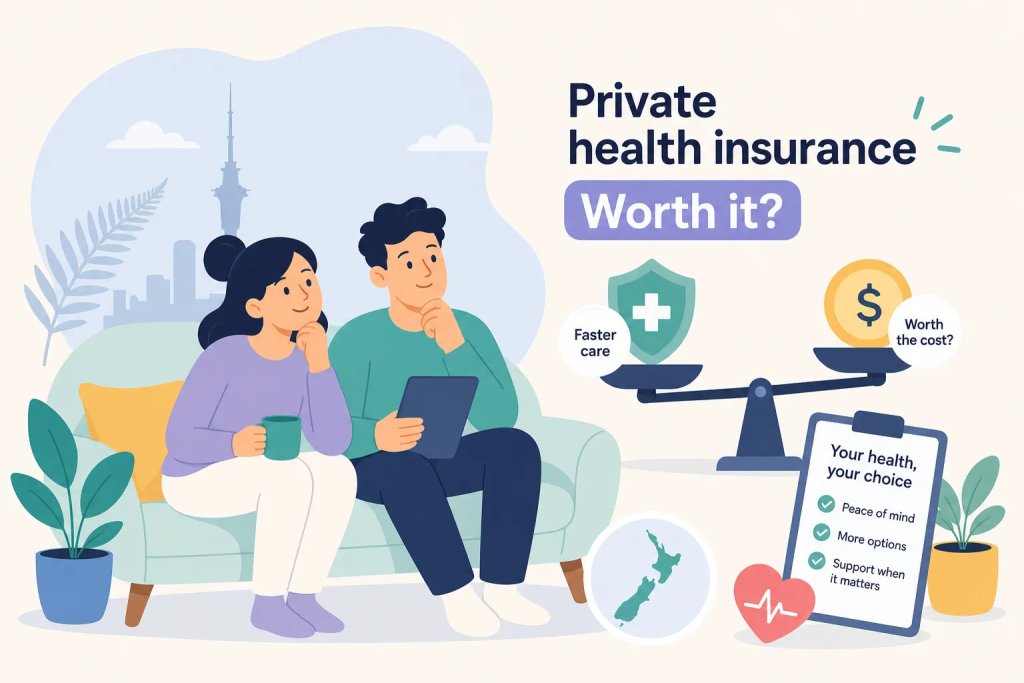
Is private health insurance worth it in New Zealand?
Is health insurance worth it in New Zealand? It’s one of the most common questions Kiwis bring to a financial adviser, and it tends to surface at a particular moment: after a family member spends eight months on a waiting list for a knee replacement, or after a premium renewal letter arrives with a figure that makes you wince. At Pulse Advice, it’s one of the most frequent conversations our advisers have, and the honest answer is always the same: it depends on your circumstances. There’s no universal right call. What there is, though, is a way to think through it clearly, using real numbers rather than fear or guesswork. No pressure to buy, no scare tactics. Just the information you need to decide for yourself.
What the public system delivers (and where it falls short)
New Zealand’s public health system genuinely performs well in the areas that matter most. Emergency and acute care are handled quickly and competently. If you’re in a serious accident or arrive at hospital with a heart attack, the public system will treat you, and treat you well. ACC also covers injury-related costs in a way that many Kiwis underestimate. The gap appears somewhere else entirely.
The real problem is elective procedures. “Elective” sounds optional. In practice, it means a knee replacement that has you limping through every workday, a cataract removal that’s made driving dangerous, or a hernia repair you’ve been putting off because the wait feels endless. The data on elective surgery waiting times in NZ is sobering. Knee replacement waits range from 107 days at Christchurch to 721 days at Southland, with Middlemore sitting at 223 days. Hip replacements average 128-plus days at Hawke’s Bay. These aren’t outliers. They’re the norm across large parts of the country.
While you wait, life doesn’t pause. Pain management costs money. Reduced physical capacity means reduced ability to work, care for children, or run a business. A tradesperson can’t swing a hammer on a deteriorating knee. A parent can’t lift a toddler with untreated back problems. The real cost of a public wait is invisible in any premium comparison, but it’s very real in daily life.
What private health insurance actually gets you
The clearest and most consistent advantage private cover delivers is speed. Private elective surgery in New Zealand typically runs one to four weeks from decision to operate. Set that against a 721-day public wait in Southland, and you’re looking at a difference of nearly two years. For procedures like knee replacement or cataract surgery, that gap isn’t just inconvenient. It’s life-altering.
Beyond surgery, private policies typically cover specialist consultations and diagnostic imaging without the delays built into the public pathway. Southern Cross data from Q1 2026 shows over 160,000 specialist consultation claims in a single quarter, which tells you something important: most policyholders aren’t primarily using cover for major surgery. They’re using it for access, for speed, for the ability to see a specialist within days rather than months.
That said, private health insurance has clear limits, and you should understand them before you commit. Common exclusions include pre-existing conditions (often permanently excluded, or covered only after waiting periods), medicines not funded by Pharmac, GP visits, dental and vision care, maternity and fertility treatment, cosmetic procedures, and long-term chronic condition management. This is not a comprehensive healthcare safety net. It’s a targeted tool for specific, time-sensitive medical events. Knowing the difference matters.
What private health insurance premiums cost in New Zealand in 2026
Health insurance premiums in NZ are tied closely to age, and the numbers shift significantly as you get older. To give you a practical sense of the range, here are typical annual costs for a non-smoking adult on a mid-range plan with a $500 excess:
- 20s: $1,000 to $2,300 per year
- 30s: $1,500 to $2,950
- 40s: $2,800 to $4,800
- 50s: $3,800 to $5,400
- 60s: $4,100 to $7,700
The curve steepens sharply after 50, which has real implications for when you decide to enter the market.
Your choice of excess shifts the numbers meaningfully. Choosing a $1,000 or $2,000 excess reduces your premium, but you absorb more of smaller claims yourself. According to Southern Cross Q1 2026 data, a private knee replacement averages around $32,000, so a high excess is often rational. You’re insuring against the big hit, not the moderate one.
Family cover (two adults and two children) typically runs $3,000 to $5,400 per year for comprehensive cover. Children’s premiums are low, often under $20 per week each. Some insurers apply multi-person discounts, so combined family cover usually works out cheaper than the sum of individual policies stacked together.
Is health insurance worth it in New Zealand for your family?
Private cover earns its premium most clearly when you live in a region with long public waits and your income depends on physical capacity. Southland, Middlemore, and Hawke’s Bay residents face some of the worst elective surgery waiting times in NZ. For a tradie, a nurse, or a self-employed business owner, a 700-day wait for a knee replacement isn’t just uncomfortable. It’s financially destabilising, and quickly so.
Age and timing matter too. Health insurance premiums in NZ are substantially lower in your 30s and 40s than in your 50s and 60s. Securing cover while you’re healthy also sidesteps the pre-existing condition exclusions that apply if you wait until something is already wrong. Once a condition is on your record, it may be permanently excluded from any new policy. The window for cost-effective entry closes over time.
If you have dependants relying on your ability to work, the equation changes further. For a primary earner supporting young children or carrying a mortgage, months out of action due to a medical issue creates a financial ripple that compounds quickly. Private cover in this situation is less about personal comfort and more about protecting the household’s stability when the timing of illness is entirely outside your control.
When private cover probably isn’t worth the premium
About 35% of New Zealand adults hold private health insurance. That means 65% don’t, and for many of them, that’s a rational decision rather than an oversight. If you’re young and healthy, have no dependants, can absorb a period without full income, and live in a region with shorter public wait times, the annual premium may not justify itself over a ten-year horizon when you run the actual numbers.
Pre-existing conditions can also significantly reduce the value of a policy. If you have a pre-exsisting condition, it may be permanently excluded. That means paying premiums that won’t help you when you need them most. Understanding precisely what a policy covers in your specific situation is critical before you sign anything.
For some Kiwis, typically higher-income earners with solid savings, self-insurance is a legitimate approach. A well-funded emergency reserve can cover a private specialist consultation or a modest procedure without ongoing premium outlay. The break-even point varies depending on your age, health history, and circumstances. It’s worth running the numbers rather than assuming that cover is always the safer choice. That assumption can be just as costly as the premium itself.
Is health insurance worth it in NZ? Questions to ask first
The questions that actually matter for this decision aren’t complicated, but most people don’t work through them systematically. How long are public waits for procedures relevant to your health history or your family’s? Does your income depend on physical capacity? Do you have dependants who rely on you being able to work? Consider two clusters: first, your health and location (wait times in your region, your age, any existing conditions); second, your financial position (what premiums would cost you now, what your savings buffer looks like, and whether you could cover a $10,000 private specialist admission if it came up next year).
Comparison websites can show you prices. They can’t ask about your health history, your mortgage, your region, or your family structure. That’s where a personalised conversation with an adviser adds real value. At Pulse Advice, advisers work through these questions with you. The focus is on identifying what level of cover, if any, actually makes sense, which policy features to prioritise, and which exclusions to watch closely for your specific situation.
A good adviser works through these questions without a predetermined product in mind. For health insurance specifically, that sometimes means recommending a policy. Sometimes it means recommending a different cover priority altogether, such as income protection or trauma cover, that will deliver more value for your dollar. Either way, you leave the conversation with clarity rather than a product you didn’t need.
The honest answer to the question
So, is private health insurance worth it in New Zealand? For some Kiwis, the answer is clearly yes: those in their 40s with dependants, in high-wait regions, or whose income depends on their physical capacity. For others, the numbers point toward self-insurance or different cover priorities. The right call depends on your personal numbers, your health history, your region, and your household situation, not on someone else’s generalisation.
If you want a clear, no-cost assessment of whether private health insurance is worth it for your situation specifically, Pulse Advice can help. The conversation is straightforward, the advice is tailored to you, and there’s no pressure to buy anything. You leave knowing where you actually stand. Get in touch with Pulse Advice to start the conversation.
This article is general information only. It does not take your personal situation into account and is not financial advice. For advice specific to you, speak to a licensed financial adviser.
