
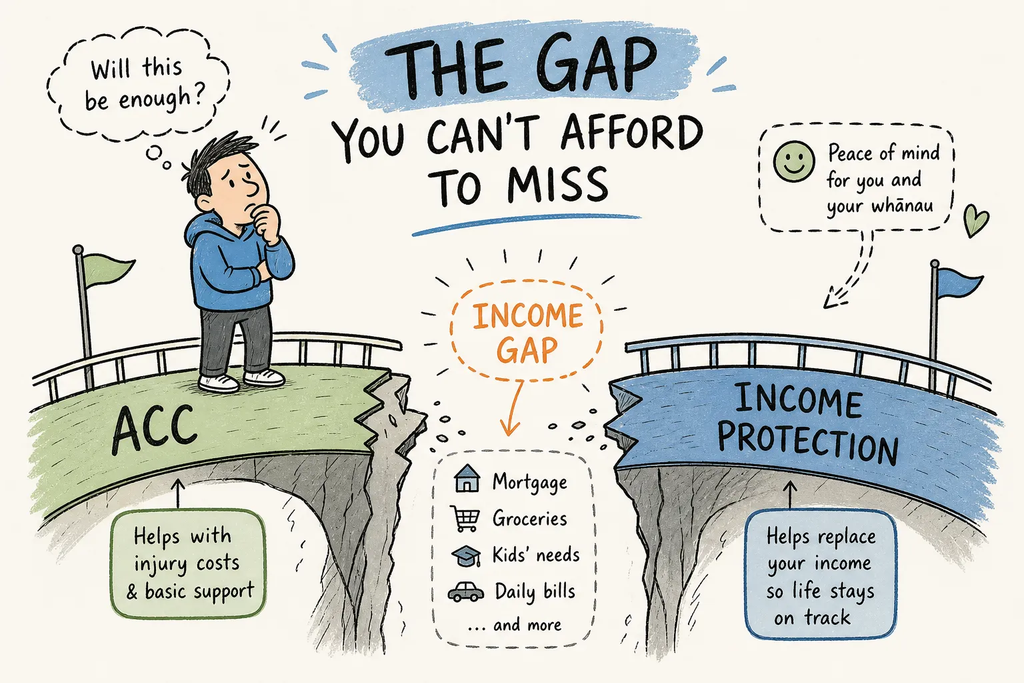
ACC vs Income Protection: The Gap Most Kiwis Miss
When comparing ACC vs income protection, most Kiwis assume ACC has them covered if something goes wrong. It’s an easy assumption to make. ACC is a compulsory, no-fault scheme that covers everyone in New Zealand, and it runs quietly in the background of every working life here. But ACC is a personal injury scheme, not an income replacement scheme. For most of the conditions that keep people off work for months, ACC pays nothing at all. This is one of the first things we clarify at Pulse Advice when someone sits down with us for the first time, and it catches a lot of people off guard.
This article breaks down exactly what ACC covers, where it stops, and how private income protection insurance fills the space it leaves behind. By the end, you’ll know whether you actually need both and what to do next.
What ACC actually covers in New Zealand
The injury-only rule that most people overlook
ACC is a no-fault personal injury compensation scheme. It covers treatment, rehabilitation, and weekly compensation when an accident causes your injury. The operative word is “accident”: slipping on a wet floor, a car crash, a torn ACL on the rugby field. If an accident caused it, ACC is likely in the picture.
Illness is a different story. There are narrow situations where ACC does step in, including work-related conditions that develop over time, recognised occupational diseases, injuries caused by medical treatment, and mental injury that follows a covered physical injury. Outside those, you’re on your own. Cancer, heart disease, stroke, and most mental health conditions sit completely outside the scheme.
That distinction matters enormously, and it’s widely misunderstood by people who have been paying their levies for years and assume that earns them broader protection than it actually does.
How weekly compensation actually works
For covered injuries, ACC replaces up to 80% of your pre-injury earnings, and that payment is capped. The maximum gross weekly compensation rate is reviewed each year, so it’s worth checking the current figure on ACC’s own site rather than relying on a number you read somewhere. There is also a minimum for full-time earners, currently $766.40 gross per week from 1 April 2026.
For self-employed Kiwis, ACC offers two options: standard CoverPlus, which pays based on your previous year’s liable earnings, and the optional CoverPlus Extra, which lets you agree a cover amount in advance for more certainty.
The key point is that ACC compensation has a ceiling. Anyone earning above that threshold faces a proportionally larger shortfall even for injuries that are fully covered.
ACC vs income protection: the income gap illness leaves behind
Illness is the risk ACC mostly doesn’t touch
Long-term absence from work is far more often caused by illness than by accident. Cancer, heart attack, stroke, serious mental health episodes: these conditions can keep someone off work for months or years, and for most people in most circumstances ACC pays nothing towards the income they lose.
Someone diagnosed with cancer will generally receive no ACC weekly compensation. The scheme does not cover illness-related income loss the way it covers accident injuries, regardless of how long that person has been paying levies or how long they’re unable to work. The income stops. The mortgage doesn’t.
What happens to your income in the meantime
Without private income protection, the options narrow quickly. You use up sick leave if you’re employed, draw down savings, lean on a partner’s income, or fall back on a government benefit.
Consider a straightforward scenario: someone earning $85,000 per year is diagnosed with a serious health condition and cannot work for six months. ACC pays nothing. Jobseeker Support is designed as a safety net, not an income replacement, and for most households it lands well short of a weekly mortgage payment. The gap isn’t theoretical. It’s the difference between staying in your home and not.
How income protection insurance fills that gap
What a policy actually pays and when
Income protection pays a monthly benefit, typically up to 75% of your pre-disability gross income, when illness or injury stops you working. Three variables determine what your policy actually does: the waiting period, the benefit period, and the payout percentage.
The waiting period is how long you’re off work before payments begin. Common options are 4, 8, or 13 weeks. The benefit period is how long payments continue, typically 2 years, 5 years, or through to age 65.
A concrete example makes this clearer. Someone earning $6,000 per month who selects a 75% benefit with an 8-week waiting period would receive $4,500 per month, starting in week nine of being off work. That’s not everything, but it’s the difference between financial survival and crisis.
ACC vs income protection, how they interact
This is where people get confused, so it’s worth being direct about it. For an injury claim, most policies offset against ACC. ACC pays first, and your private insurer then tops up to your insured benefit level rather than paying on top of it. If ACC pays $800 per week and your policy benefit is $1,000 per week, your insurer pays the $200 difference. How the offset works varies between insurers and between policy types, so it’s worth knowing what your own wording says.
For illness claims, there is no ACC payment at all, which means income protection carries the full load on its own. This is why income protection does most of its real work as sickness cover, even though it technically covers both injury and illness. The illness side is where the exposure sits for most New Zealanders.
What income protection costs in NZ, and how to manage it
What drives the price
Cost is usually the first objection, so it’s worth understanding what actually moves the number before you ask for one.
Five things do most of the work. Your age, because risk rises with it. Whether you smoke, which can roughly double the premium on its own. Your occupation, since trades and physical work cost materially more than office-based cover. Your health history, which affects both the price and what gets excluded. And the way the policy is structured, which is the part you have the most control over.
That last one matters more than people expect, and it’s covered below.
The two things worth knowing up front: premiums rise steeply between your thirties and your fifties for the same cover, and the earlier you put cover in place the fewer health-related exclusions you’re likely to carry. Waiting is the one variable that only ever moves against you.
Beyond that, quoted ranges aren’t much use. Two people the same age on the same income can be priced very differently once occupation and health history are in the mix, so the only number that means anything is one worked out on your actual situation.
How waiting period and benefit period affect what you pay
Two levers are available to manage cost without gutting the value of your cover.
First, the waiting period. Moving from a 4-week to a 13-week wait can cut your premium substantially, because you’re carrying the first three months yourself. If you have savings or employer sick leave to bridge that gap, it’s a sensible trade-off.
Second, the benefit period. A two-year benefit period costs considerably less than cover that runs through to age 65, but it also stops paying after two years, which is a real risk with conditions that don’t resolve quickly.
The right combination depends on your situation: how long your savings would last, whether your employer pays sick leave, and what your mortgage or rent obligations look like. Defaulting to the cheapest option isn’t always the smartest move. You need to understand what you’re giving up before you make that call.
Getting the right balance of cover for your situation
The question isn’t either/or
Most Kiwis don’t choose between ACC and income protection, because you have ACC by default. The real question is whether income protection belongs in your financial setup on top of it.
As a general guide, if you’re employed with dependants, carrying a mortgage, or self-employed without employer-paid sick leave, income protection is worth taking seriously. Illness doesn’t give you advance notice, and the gap between your last pay and a government benefit is rarely comfortable. The sooner cover is in place, the lower the premiums and the fewer pre-existing condition exclusions you’re likely to encounter. Waiting until something happens is not a strategy. It’s just being uninsured with extra steps.
How Pulse Advice makes this straightforward
At Pulse Advice, this is exactly the kind of conversation we have with clients every day. The right benefit period, the right waiting period, the right insurer for your occupation and health history: these aren’t things you should guess at or try to work out from a comparison website. We review your situation, explain your options in plain language, and handle the paperwork and applications on your behalf.
Like many financial advisers in New Zealand, Pulse Advice receives remuneration from insurance providers rather than charging clients directly. The full breakdown is set out in our public disclosure, and we’d encourage you to ask us how it works before you proceed. What you get is advice built around your situation, without the sales pressure.
The gap is real, and it’s fixable
ACC is a strong foundation for accident cover, and New Zealand should be proud of it. But when comparing ACC vs income protection, the picture is clear. Illness is where most long-term income loss actually happens, and for the most part ACC doesn’t touch it. Income replacement insurance is the mechanism that closes that gap. The cost is more manageable than most people expect, especially when the policy is structured well for your circumstances. The risk of not having it is far more expensive than the premium.
If you’re not sure whether your current cover is enough, or you’ve never looked into income protection at all, a conversation with Pulse Advice is a sensible place to start. No pressure, just a clear picture of where you stand and what your options are.
This article is general information only and doesn’t take your personal circumstances into account. For advice specific to your situation, get in touch with us.
